
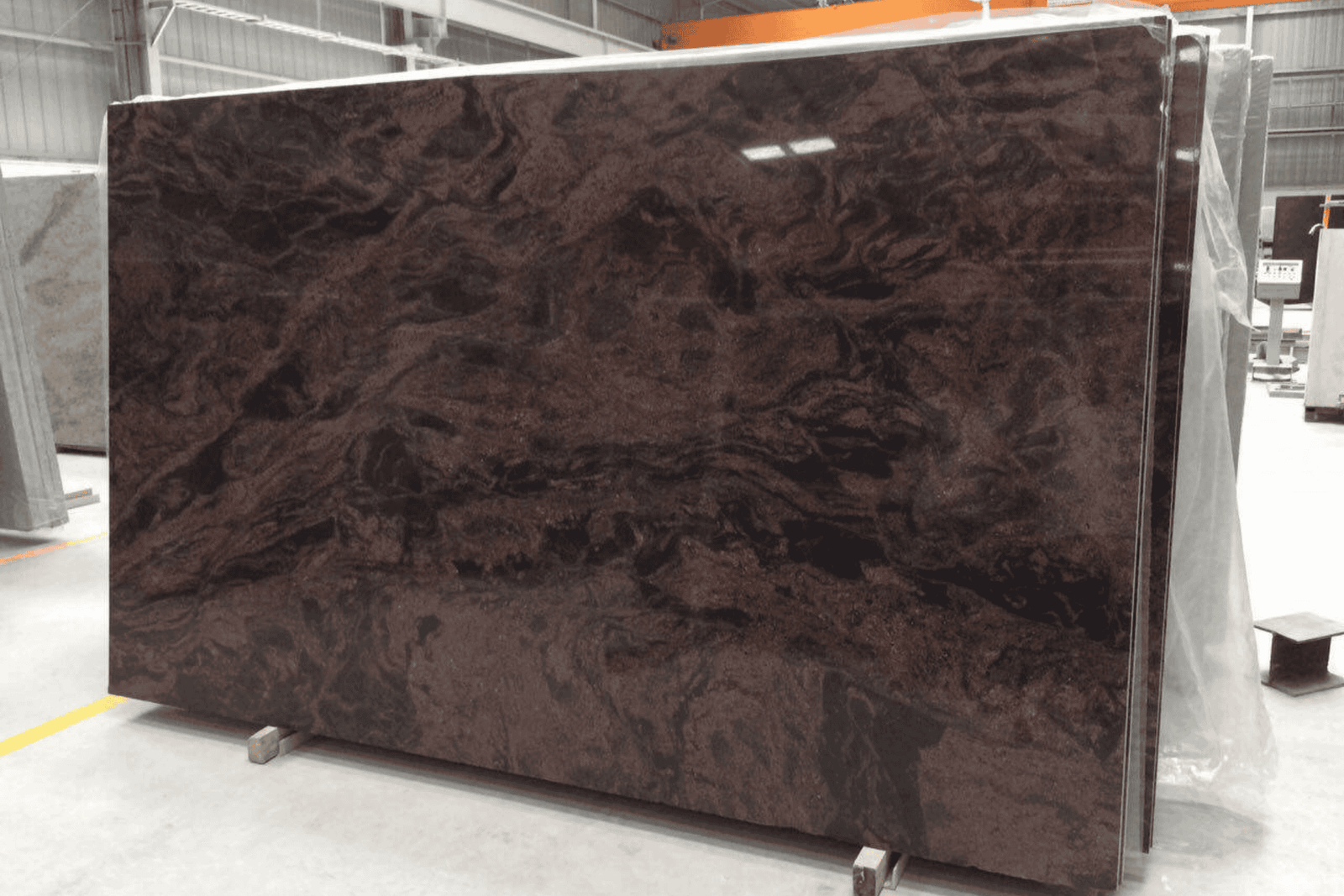
By the late 1990s, Aurora granite from Finland had cemented itself as a default choice for high-end residential and commercial projects worldwide. It was beautiful, expensive, and hard to source — particularly in the volumes Indian and Asian builders were beginning to demand. We were sitting on a quarry in Srikakulam producing stone that, geologically, told a remarkably similar story. The question was whether the global market was ready to hear it.
Naming a category
In 2000, we made a decision that felt audacious at the time. Rather than position our material as “like Aurora” or “an alternative to Aurora,” we coined a name of its own — Indian Aurora. It was a small linguistic move with a large strategic intent: to give buyers a category they could specify by name, not just describe by comparison.
The first shipments left for Germany and Italy in mid-2000. Importers were skeptical. Architects, in our experience, were quicker to grasp it. Within eighteen months, “Indian Aurora” had begun appearing on specification sheets in three continents.
“We didn’t invent the stone. We invented the way the world could refer to it — and that turned out to matter just as much.”
What the market wanted
The story of Indian Aurora isn’t really about marketing. It’s about supply chains. By owning the quarry directly, we could promise buyers something Finnish suppliers struggled with at the volumes Asian projects required: consistency. Block after block, container after container, the same colour, the same grain, the same finish.
That predictability is what kept Indian Aurora on architects’ lists year after year. It’s also what eventually let us expand the category — pioneering matching marble frontiers in Ethiopia, Zambia, and Tanzania a decade later.
Twenty-six years on
Today, Indian Aurora ships to over 40 countries from our Srikakulam operations. Newer Indian and African quarries have entered the category, but the original quarry — the one that started it all — is still ours, still operating, still producing the same coarse-grained, golden-veined stone we shipped in those first containers.
That kind of continuity is rare in this industry. It’s also exactly what we mean when we say generational integrity — the kind that takes three decades to build, and one shipment to lose.